
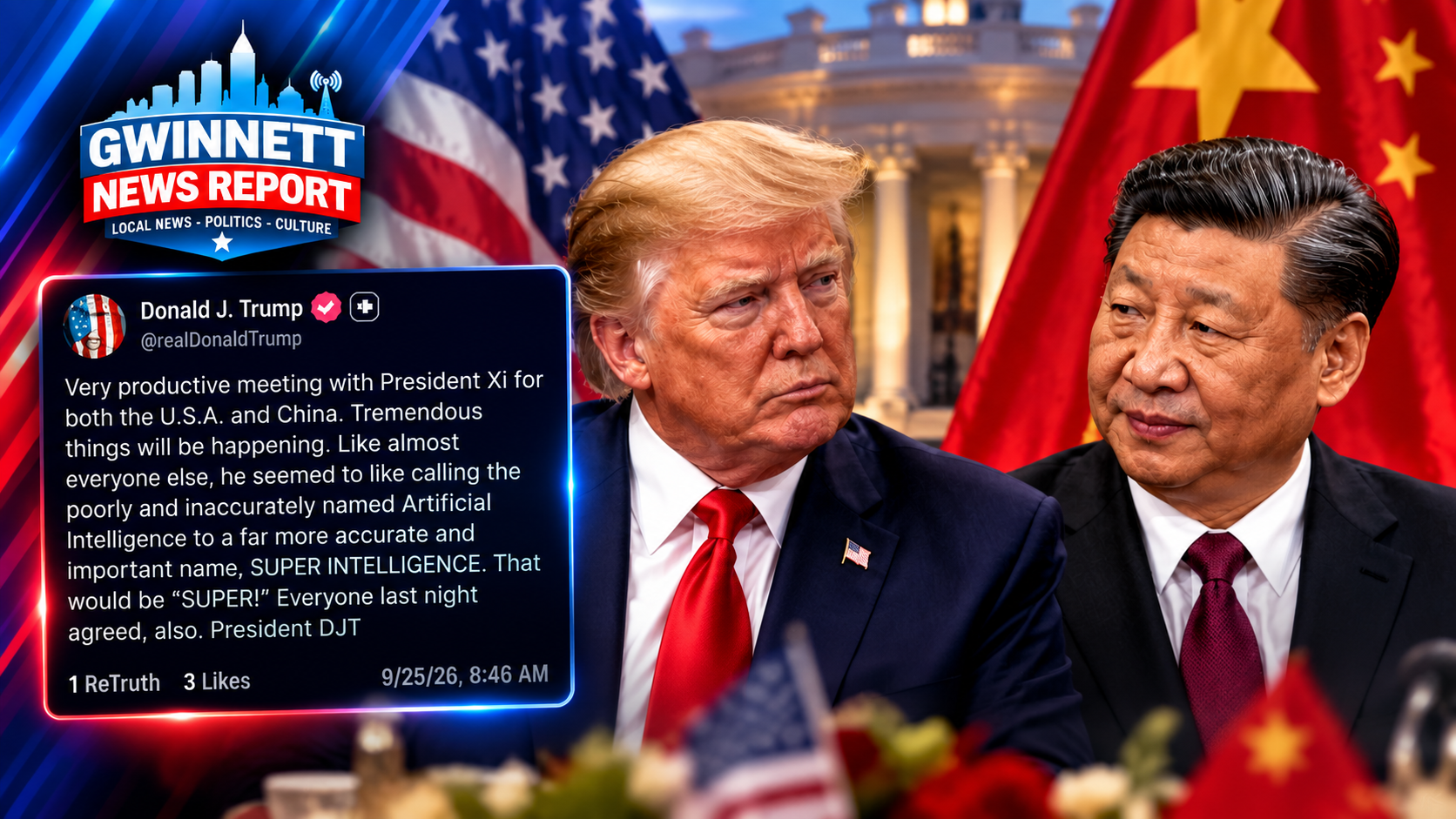
WASHINGTON — In a recent post on Truth Social dated September 25, 2026, President Donald Trump reflected on a meeting with Chinese President Xi Jinping, revealing that they engaged in discussions about the evolving landscape of artificial intelligence, among other pressing global issues. During this meeting, Trump introduced a new term he coined, “SUPER INTELLIGENCE,” which he claims resonates more accurately with the capabilities of advanced AI systems.
In the post, Trump expressed that both leaders found merit in rebranding artificial intelligence, which he referred to as “poorly and inaccurately named.” He stated, “Like almost everyone else, he seemed to like calling the poorly and inaccurately named Artificial Intelligence to a far more accurate and important name, SUPER INTELLIGENCE.” This new terminology, according to Trump, was well-received, with Xi reportedly endorsing the idea and both leaders reaching a consensus that “everyone agreed” the term should be adopted.

Screenshot provided by Gwinnett News Report.
However, Trump’s remarks did not clarify how this proposed change in terminology would be integrated formally into the lexicon of the U.S. government, private technology companies, or any international institutions. The term “artificial intelligence” continues to be the standard phrase used worldwide to refer to technologies designed to execute tasks that generally require human cognitive functions, such as generating text, analyzing vast data sets, and recognizing intricate patterns.
This exchange comes at a time when the United States and China are in the midst of critical negotiations concerning technology, trade, and broader bilateral relations. Both the White House and the Chinese government have underscored the significance of keeping lines of communication open between the two nations, particularly as tensions persist regarding trade policies and technological advancements.
Trump’s introduction of “SUPER INTELLIGENCE” seems more like a personal promotion of a new concept rather than an officially recognized technical replacement for the term currently in use. His comments arise amid a growing global discourse focusing on the capabilities of advanced AI systems and the urgent need for effective regulation and safety measures, as well as considerations of their potential economic impact on various sectors.
Concluding his post, Trump described the dialogue with Xi as “productive” and hinted at the possibility of more significant developments emerging in the future, reflecting a forward-looking approach to U.S.-China relations in the context of technology and innovation.
Leave a Reply