
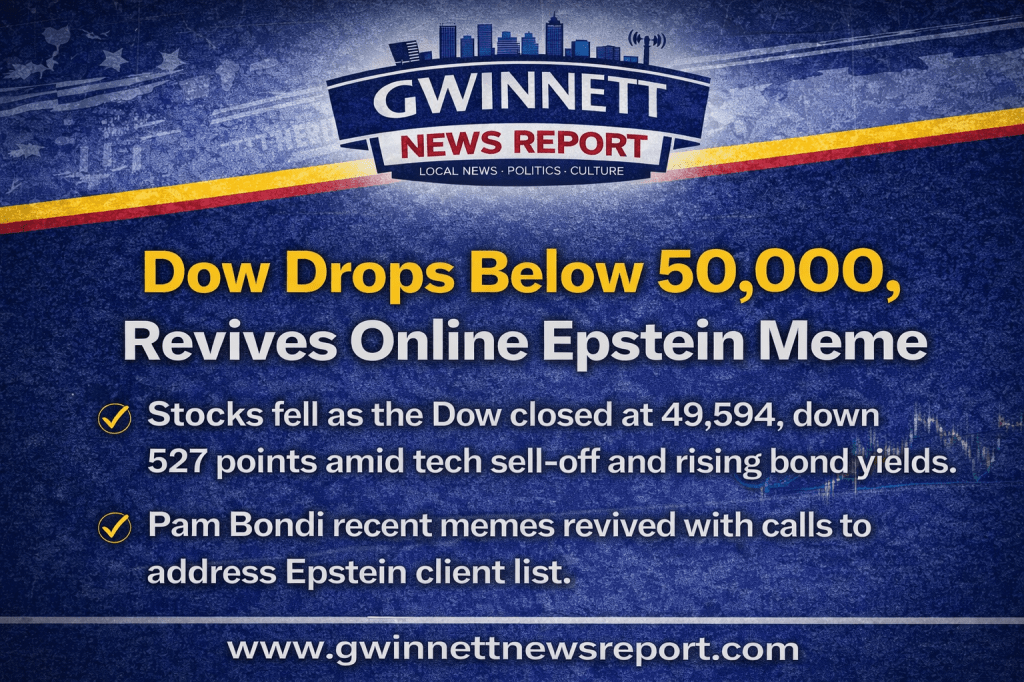
U.S. stocks fell sharply Thursday, sending the Dow Jones Industrial Average below the 50,000 mark amid a broad market sell-off that hit major technology companies and reignited online political commentary.
The Dow closed at 49,594, down 527 points, as investors reacted to rising bond yields, concerns over artificial intelligence valuations, and renewed volatility across global markets. The sell-off weighed heavily on technology stocks, with shares of Nvidia, Apple, and Meta among the biggest decliners of the session.
Market analysts pointed to a combination of profit-taking and uncertainty around interest rates as contributors to the downturn. Recent economic data has fueled speculation that higher-for-longer rates could continue to pressure growth stocks, particularly in the tech sector, which has driven much of the market’s gains in recent months.
Beyond Wall Street, the market drop also sparked a wave of online commentary, reviving a political meme tied to Florida Attorney General Pam Bondi and her recent testimony before the U.S. House Judiciary Committee. During the hearing, Bondi highlighted strong market performance in response to questions related to the Justice Department’s handling of Jeffrey Epstein-related files.
As the Dow fell below 50,000, critics on social media resurfaced past comments and memes suggesting that market performance was being emphasized while questions surrounding Epstein’s client list and potential arrests remained unanswered. One widely shared post joked that the market dip signaled it was “time to talk Epstein,” reflecting frustration among some online users.
Despite the renewed attention, no new developments related to the Epstein case were announced during or after the market decline. Federal officials have not released additional information, and no new arrests or disclosures were reported Thursday.
Financial experts cautioned against linking short-term market movements to political narratives, noting that Thursday’s sell-off aligned with broader trends tied to inflation concerns, bond market pressures, and shifting investor sentiment toward high-growth stocks.
“The volatility we’re seeing is more about macroeconomic conditions than headlines,” said one market strategist. “Rising yields and uncertainty around future rate cuts are creating a challenging environment for equities.”
As markets continue to fluctuate, investors are expected to closely monitor upcoming economic data and signals from the Federal Reserve. Meanwhile, the resurgence of political memes highlights how financial news and political discourse increasingly intersect in the digital age.
 Gwinnett News Report
Leave a comment